
Flashlight Safety Guide 2026: Essential Tips for Safe Use

A flashlight seems pretty simple. Turn it on, point it where you need some light, and you're done.
But today's flashlights are a little different from the ones many of us grew up with. High-power LEDs can produce a lot of light, rechargeable batteries are now common, and many models come with USB-C charging, motion sensors, waterproof protection, multiple lighting modes and other useful features.
That makes flashlights more capable than ever. It also means there are a few things worth paying attention to.
The good news is that most flashlight safety problems are easy to avoid. Check the battery before use, don't leave a high-power light running unnecessarily, keep charging ports dry, and never point a bright beam or laser at someone's eyes.
In this guide, we'll cover the most practical flashlight safety tips for everyday use, camping, driving and emergency situations. We'll also look at battery safety, waterproofing, overheating and some common mistakes that are easy to overlook.
# Quick Navigation
- 1. Check the Battery Before Use
- 2. Don't Ignore Heat
- 3. Charge Rechargeable Flashlights Carefully
- 4. Know What Your Waterproof Rating Means
- 5. Protect Your Flashlight from Drops and Impact
- 6. Don't Look Directly into a High-Power Beam
- 7. Keep Children Supervised
- 8. Store Your Flashlight Properly
- 9. Keep the Lens and Battery Compartment Clean
- 10. Use the Right Lighting Mode
- 11. Flashlight Safety in Emergencies
- 12. Avoid Using a Flashlight in Dangerous Ways
- 13. Common Flashlight Safety Mistakes
- 14. Battery Types: Which One Is Right for a Flashlight?
- 15. Flashlight Safety for Different Situations
- 16. Simple Flashlight Cleaning and Maintenance
- Frequently Asked Questions
1Check the Battery Before You Use the Flashlight
Battery safety should always come first.
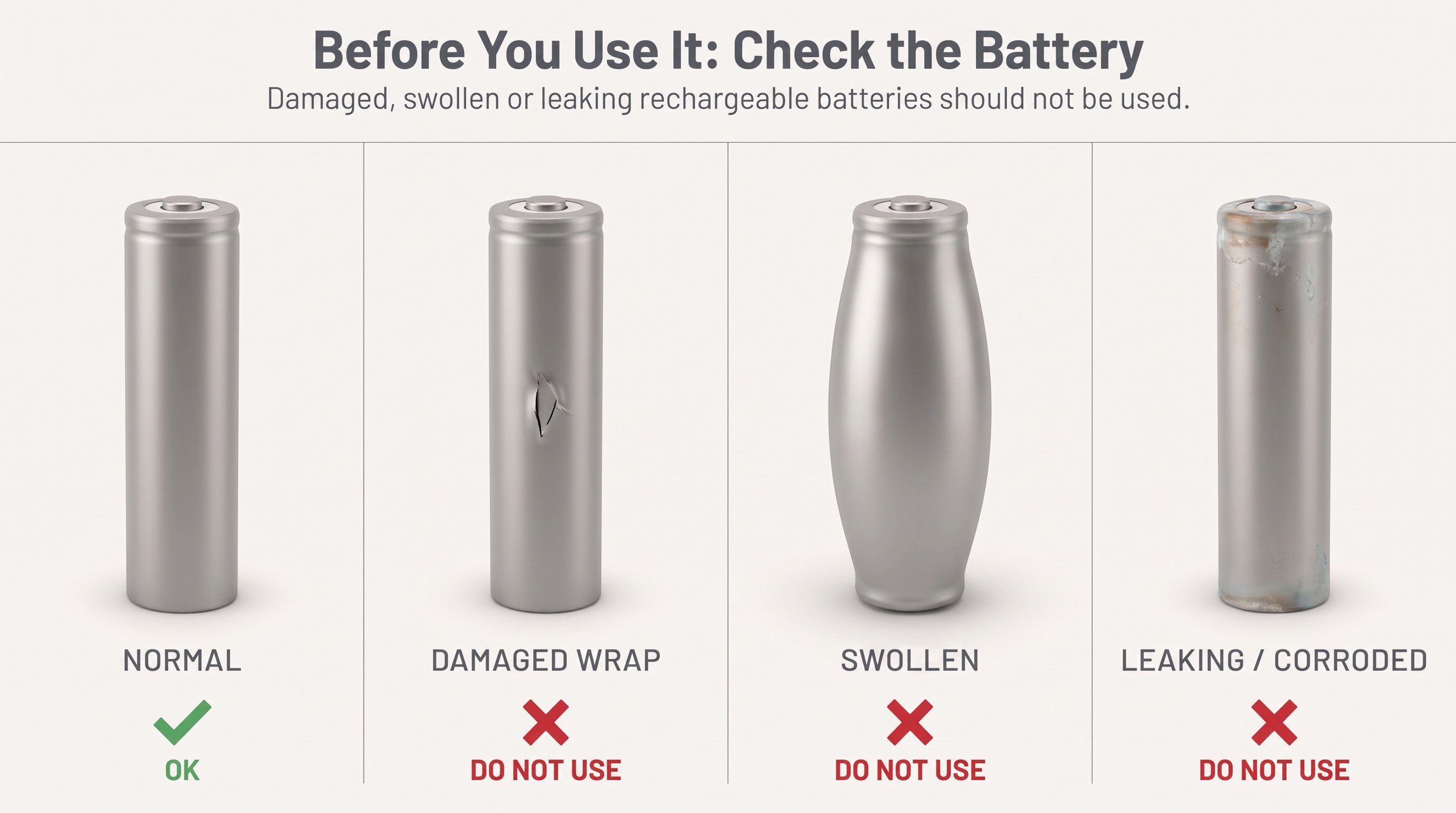
Before putting a battery into a flashlight, take a quick look at it. If you see swelling, leakage, corrosion, a damaged outer wrap or other obvious damage, don't use it.
This is especially important with rechargeable lithium-ion batteries such as 18650 and 21700 cells. These batteries are widely used in high-output flashlights because they can provide a lot of energy in a relatively small package. But they also need to be handled properly.
A quick battery check only takes a few seconds. Look for:
- Swelling or deformation
- Leaking fluid
- Corrosion
- Damaged battery wrapping
- Burn marks or unusual discoloration
- Loose or damaged terminals
Also make sure you're using the battery type recommended for the flashlight. Don't assume that a battery will work just because it fits physically.
If a battery looks damaged, replace it. Don't try to make it work one more time.
For buyers sourcing flashlights, battery information is also worth checking early in the process. Battery type, capacity, charging method and compatibility can have a big effect on the final product.
2Don't Ignore Heat from High-Power LEDs
High-power flashlights producing hundreds or even thousands of lumens is going to generate some heat. That's normal.
The important thing is how that heat is managed.
When a high-output flashlight runs at maximum brightness for a long time, the LED and electronic components can become quite warm. A good flashlight needs a way to move that heat away from the LED and other sensitive parts.
This is one reason aluminum flashlight housings are common in outdoor and high-power models. Aluminum can help transfer heat away from the LED and electronics.
A few simple rules:
- Don't cover the flashlight head while it is running.
- Don't leave a high-power flashlight on unnecessarily.
- Let the flashlight cool after extended use.
- Avoid leaving it running against clothing, bedding or other materials that can trap heat.
- Don't leave a flashlight or spare battery in extreme heat for long periods.
And here's something that is easy to forget:
The brightest mode isn't always the best mode.
If you're reading in a tent, walking around the house or looking for something in a car, you probably don't need maximum output. A lower setting will often be more comfortable and will give you much longer runtime.
For flashlight buyers, this is also why looking only at the highest lumen number can be misleading. Brightness, runtime and heat management all matter.

3Charge Rechargeable Flashlights Carefully
USB-C has made rechargeable flashlights much easier to live with. You can often use the same type of cable you already carry for other devices.
But USB-C doesn't mean that every charger, cable or battery combination is automatically suitable.
Use the charging method specified by the flashlight manufacturer.
Before charging:
- Check that the battery is in good condition.
- Make sure the charging port is clean and dry.
- Use the recommended cable and power source.
- Charge the flashlight in a dry, ventilated place.
- Don't charge a visibly damaged or swollen battery.
- Don't cover the flashlight while it is charging.
If the flashlight becomes unusually hot, develops an unusual smell or behaves strangely during charging, stop charging it.
For products using removable lithium-ion batteries, buyers should also check whether the flashlight has built-in charging, an external charger requirement, or specific battery protection requirements.
These details may not sound exciting, but they matter once the product is actually in the hands of the customer.
4Know What Your Waterproof Rating Actually Means
A flashlight advertised as waterproof is not necessarily designed to be thrown into a swimming pool.
Most water-resistant flashlights use an IP rating to describe their protection against dust and water. The rating gives you a better idea of what the flashlight can handle, but it should always be read together with the manufacturer's specifications.
A flashlight may be suitable for rain, splashes or temporary immersion depending on its specific rating and design.
However, waterproof protection can be affected by things such as:
- Damaged seals
- A loose tail cap
- An incorrectly installed battery
- Cracked housing
- A damaged charging-port cover
- Long-term exposure to water beyond the product's rated conditions
There's another important rule:
Don't charge a wet flashlight.
If you've been using it in heavy rain, dry the flashlight and make sure the charging port and other relevant areas are dry before connecting a cable.
And remember, salt water is especially harsh on metal parts and electronics. If a flashlight has been exposed to seawater, follow the manufacturer's cleaning instructions rather than simply putting it away.

5Protect Your Flashlight from Drops and Impact
Outdoor flashlights are usually built to handle a reasonable amount of rough use. Aluminum bodies, impact-resistant materials and protective structures can make a big difference.
But no flashlight is indestructible.
A hard drop can damage the LED, circuit board, switch, battery contacts or waterproof seals even when the outside still looks fine.
If your flashlight has taken a serious fall, give it a quick inspection before relying on it. Check:
- The lens
- The housing
- The switch
- The battery compartment
- The charging port
- Any waterproof seals
If something is loose, cracked or behaving differently after the impact, don't ignore it.
For outdoor and professional applications, durability is more than just having a strong-looking shell. Impact resistance, waterproof protection, battery design and internal construction all play a part.
6Don't Look Directly into a High-Power Flashlight Beam
This one is simple:
Don't look directly into a high-intensity flashlight beam, and don't shine it into someone else's eyes.
A powerful beam can be especially uncomfortable when your eyes are already adjusted to darkness. The sudden glare can cause temporary visual discomfort and make it harder to see clearly for a short time.
This matters when using flashlights for:
- Hiking
- Camping
- Cycling
- Security
- Worksites
- Night driving
- Search and rescue
Point the beam where you need it rather than toward people's faces.
What about flashlights with a laser function?
Some multifunction flashlights include a laser pointer in addition to the LED light. That requires extra care.
Never point a laser at an aircraft.
Laser light can interfere with a pilot's vision and create a serious aviation safety risk. In the United States, intentionally aiming a laser at an aircraft is prohibited under federal law.
So if you're using or sourcing a flashlight with a laser function, treat the laser as a separate safety feature—not simply another lighting mode.
7Keep Children Supervised When Necessary
Flashlights are generally simple to use, but younger children may not understand the risks of bright light or loose batteries.
If a child is using a flashlight, teach them a few basic rules:
- Don't shine the light into anyone's eyes.
- Don't open or play with the battery compartment.
- Don't play with loose batteries.
- Don't use damaged charging cables or batteries.
- Ask an adult for help if something seems wrong.
Keep spare batteries somewhere children cannot easily access them.
For products designed specifically for children, battery access and overall product construction deserve particular attention during product development.
8Store Your Flashlight Properly
A flashlight doesn't need complicated storage. It just needs the right conditions.
Keep it somewhere cool, dry and easy to reach.
For long-term storage:
- Keep it away from direct sunlight and excessive heat.
- Check the battery occasionally.
- Keep spare batteries away from metal objects.
- Don't store damaged batteries.
- Follow the manufacturer's instructions about removing the battery during long periods of non-use.
If you keep a flashlight in your car, remember that the inside of a parked vehicle can become extremely hot. That's not ideal for batteries or electronics.
An emergency flashlight is only useful if it still works when you need it.
9Keep the Lens and Battery Compartment Clean
Sometimes a flashlight seems less bright simply because the lens is dirty.
Dust, fingerprints and dirt can reduce the amount of useful light coming out of the flashlight. Battery contacts can also become dirty or corroded over time.
Every now and then, check:
→
Housing
→
Switch
→
Charging Port
→
Battery Compartment
Use a soft cloth to clean the lens and exterior. For the battery compartment, check for corrosion or leakage.
If you notice a cracked lens, damaged housing, loose switch or damaged charging port, it's better to deal with the problem early rather than wait for the flashlight to fail completely.
This is particularly important for an emergency flashlight. You don't want to discover a dead battery or corroded contact during a power outage.
10Use the Right Lighting Mode
Modern flashlights often come with more modes than you might expect:
Medium
Low
Strobe
SOS
Sensor mode
Red light
UV light
Other specialty modes
It's tempting to use High all the time. Most of the time, you don't need to.
For example:
Inside a tent: Low or medium may be enough.
Walking a trail: Medium can offer a good balance between visibility and runtime.
Searching a large outdoor area: High may make sense.
Using the right mode can make the battery last longer and reduce unnecessary heat.
It also makes the flashlight more comfortable to use. A 1,000-lumen beam isn't necessarily helpful when you're standing one meter away from the object you're trying to see.
11Flashlight Safety in Emergency Situations
A flashlight becomes especially valuable when something goes wrong.
During a power outage, roadside emergency or unexpected outdoor situation, you may need it immediately—and you may not have time to figure out how it works.
That's why an emergency flashlight should be simple to operate.
During a power outage
Use the flashlight to light stairs, floors and walking areas. Avoid pointing it directly into people's faces.
During a roadside emergency
A flashlight can help you see around the vehicle at night, but stay aware of traffic and use proper warning equipment where necessary.
During camping or hiking
Keep the flashlight somewhere easy to reach. Don't bury it at the bottom of your backpack.
If your flashlight has an SOS or strobe mode, know how to activate it before you actually need it.
A small amount of preparation can make a big difference in an emergency.
12Avoid Using a Flashlight in Dangerous Ways
A flashlight is designed to provide light. It shouldn't be used as a weapon, a heating tool or a way to deliberately distract other people.
Avoid using a flashlight to:
- Intentionally blind someone
- Distract drivers
- Point a laser at aircraft
- Modify electrical components without proper knowledge
- Charge an incompatible battery
- Operate a visibly damaged battery
- Use the product outside its rated conditions
If your flashlight includes additional functions such as a laser, UV light, USB output or sensor, make sure you understand what each function is designed to do.
13Common Flashlight Safety Mistakes
Most flashlight problems don't come from complicated situations. They're usually caused by small things that are easy to overlook.
| Mistake | What Can Happen | Better Approach |
|---|---|---|
| Using a damaged battery | Safety risk or poor performance | Replace it |
| Using the wrong battery | Damage or malfunction | Follow the manufacturer's specifications |
| Running High mode unnecessarily | More heat and faster battery drain | Use the lowest useful mode |
| Charging while wet | Possible electronic damage | Dry it first |
| Assuming "waterproof" means unlimited immersion | Water can still enter the product | Check the IP rating |
| Looking into a high-power beam | Strong glare and temporary visual discomfort | Keep the beam away from eyes |
| Leaving it in a hot car | Heat can affect batteries and electronics | Store it in a more suitable place |
| Ignoring damage after a drop | Hidden internal damage may remain | Inspect it before reuse |
| Pointing a laser at an aircraft | Serious aviation safety risk | Never do it |
14Flashlight Battery Types: Which One Is Right?
There isn't one battery that is best for every flashlight.
The right choice depends on the flashlight design, output, expected runtime and how the product will be used.
| Battery Type | Main Advantage | Things to Consider |
|---|---|---|
| Alkaline | Easy to find and inexpensive | Not ideal for every high-output application |
| Disposable lithium | Long shelf life and good energy density | Follow the manufacturer's specifications |
| Rechargeable Li-ion | High energy density and reusable | Needs proper charging and handling |
| 18650 | Compact and widely used | Must be compatible with the flashlight |
| 21700 | Higher capacity potential in many designs | Larger size requires a suitable flashlight |
For rechargeable flashlights, battery compatibility matters more than simply choosing the battery with the largest capacity number.
The flashlight's electronics, charging system and battery protection all need to work together.
This is something worth discussing with a supplier before placing a larger order, especially for private-label or OEM products.
15Flashlight Safety for Different Situations
The "right" flashlight can be very different depending on where it will be used.
At Home
For power outages and everyday use, convenience is usually more important than extreme brightness.
Choose a flashlight that is easy to find, easy to operate and simple to recharge or replace the batteries in.
Camping and Hiking
Outdoor users normally care more about waterproof protection, impact resistance, battery life and comfortable operation when choosing outdoor flashlights.
A flashlight that works well in a living room may not be the best choice for a rainy hiking trail.
In a Vehicle
Keep the flashlight somewhere accessible rather than buried under luggage.
Check its battery from time to time, particularly before a long road trip.
If you use a rechargeable model, be aware of temperature extremes inside vehicles.
At a Worksite
Worksite flashlights and work lights may have to deal with dust, rain, drops and long operating periods.
Depending on the application, buyers may want to look at:
- Housing material
- Impact resistance
- IP rating
- Runtime
- Heat management
- Battery configuration
- Charging method
- Mounting options
There is no need to pay for features your customers won't use. The better approach is to start with the actual working environment and build the specification from there.

16How to Clean and Maintain a Flashlight
Flashlight maintenance doesn't have to be complicated. A quick check every now and then is usually enough.
Turn it off. Disconnect the charging cable before cleaning.
Clean the lens. Use a soft, clean cloth to remove dust and fingerprints.
Check the housing. Look for cracks, dents, loose parts or other damage.
Check the battery compartment. Look for corrosion, leakage or damaged contacts.
Check the charging port. Make sure it is clean and dry before charging.
Check waterproof seals. If the flashlight is designed for water resistance, make sure the relevant seals and covers are still in good condition.
Test it. Turn it on and check the main lighting modes, switch and charging function before putting it away.
That's it. A few minutes of basic maintenance can save you from finding out that the flashlight has a problem when you actually need it.
17Frequently Asked Questions
Can looking directly into a flashlight beam damage your eyes?
It's best not to look directly into a high-power flashlight beam.
A bright beam can cause strong glare and temporary visual discomfort, especially when your eyes are already adjusted to darkness. The safest approach is to point the flashlight toward the area you need to see rather than someone's face.
How often should I replace flashlight batteries?
There isn't a fixed replacement schedule for every battery.
Replace disposable batteries when they are depleted, leaking or damaged. Rechargeable batteries should be replaced when they show physical damage or significant loss of performance, following the battery manufacturer's guidance.
Is it safe to leave a flashlight on overnight?
It depends on the flashlight and the lighting mode.
Leaving a high-output flashlight running for many hours can generate considerable heat and drain the battery quickly. If you need light for a long period, a lower setting is usually a better choice.
Can I charge a flashlight with any USB-C charger?
Not necessarily.
USB-C describes the connector, but different products can have different charging requirements. Use the charging method recommended by the flashlight manufacturer and check the product's input specifications.
Is an IP-rated flashlight completely waterproof?
No.
An IP rating describes the level of protection under defined test conditions. It does not mean the flashlight can handle unlimited exposure to water.
Always check the specific IP rating and the manufacturer's instructions before using a flashlight underwater or in heavy rain.
Can I use an 18650 battery in any flashlight?
No.
The flashlight needs to be designed for that battery type and its electrical characteristics. Check the manufacturer's specifications before installing an 18650 or any other rechargeable lithium battery.
Why does my high-lumen flashlight get hot?
Some heat is normal when a high-power LED flashlight is running.
The higher the output, the more heat the LED and electronics may produce. Good flashlight designs use the housing and other thermal management methods to move that heat away from sensitive components.
If the flashlight becomes unusually hot, turn it off and allow it to cool.
Can I point a flashlight at an aircraft?
You should never intentionally point a laser at an aircraft.
Laser light can interfere with a pilot's vision and create a serious safety risk. In the United States, intentionally aiming a laser at an aircraft is prohibited by federal law.
18Choosing the Right Flashlight Matters Too
Flashlight safety isn't only about what you do after buying a product. The product itself needs to be suitable for the job.
A flashlight for occasional home use doesn't necessarily need the same specifications as one designed for hiking, security, professional work or emergency use.
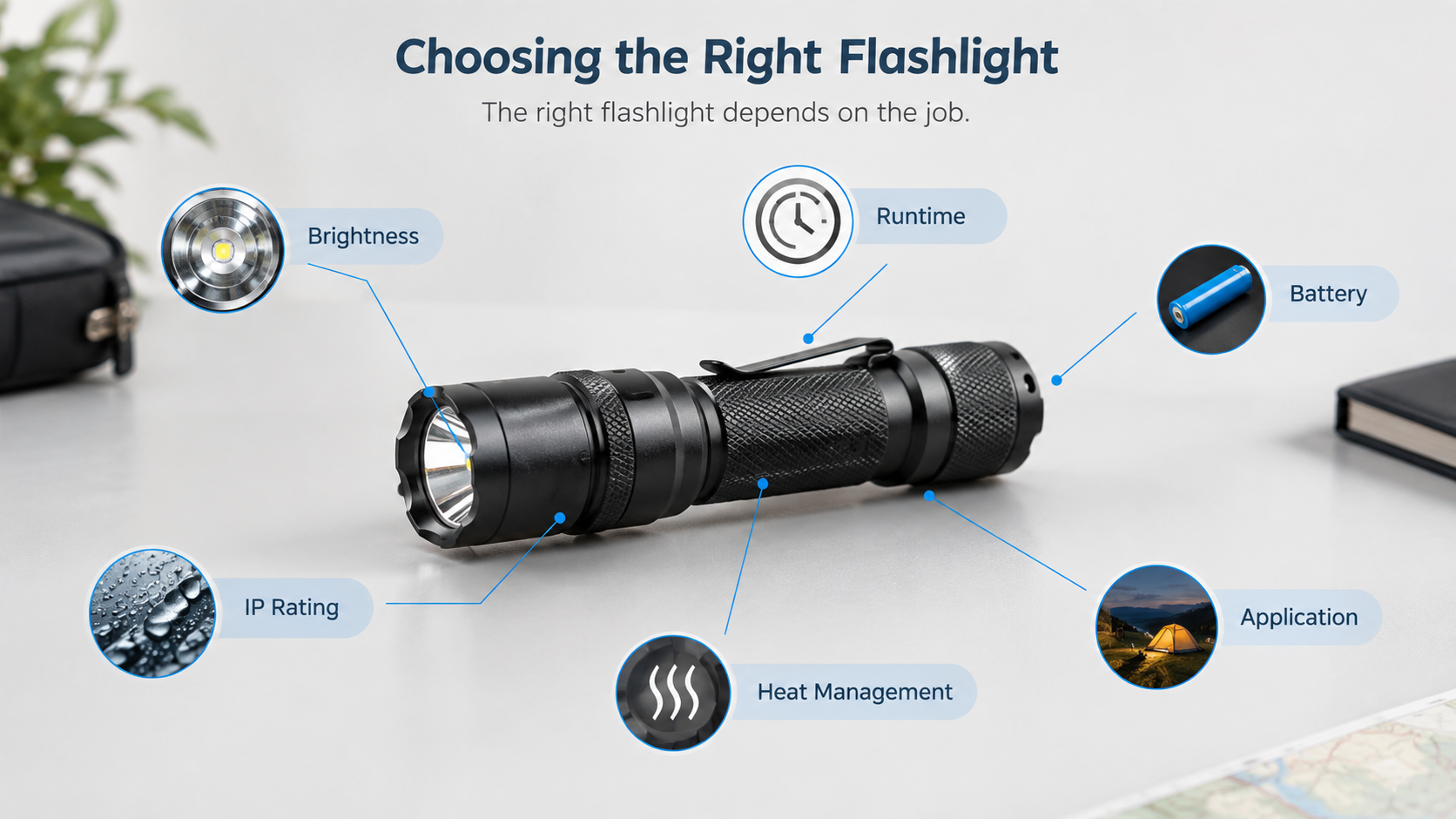
Depending on the application, things like these may matter:
Runtime
Battery type
Heat management
Waterproof protection
Impact resistance
Charging method
Size
Controls
And this is where we think the conversation should go beyond simply asking, "How many lumens does it have?"
A very bright flashlight isn't necessarily the right flashlight if the battery runs out quickly, becomes too hot during extended use, or doesn't match the environment where your customers will use it.
At HappylightTime, we work with wholesalers, importers, retailers and brands looking for different flashlight and outdoor lighting solutions. Depending on the project, we can support product selection as well as OEM/ODM development and customization.
If you're sourcing flashlights for your market, tell us what you need—such as the application, target brightness, battery type, quantity or other requirements.
We'll help you look at the product from the practical side, not just the specification sheet.
Safe flashlight use is not complicated. Choose the right product, use it within its intended conditions, take care of the battery, and don't ignore small signs of damage. A few simple habits can make a flashlight safer, more reliable and much more useful when you actually need it.
Published by Yunsheng Team
Ningbo Yunsheng Electric Co., Ltd. specializes in LED flashlights, camping lights, headlamps, and solar lighting products for global wholesale buyers. Contact us for OEM/ODM inquiries.
Post time: Nov-07-2024