
OEM Solar Light Manufacturer vs Trading Company: What's the Difference?

Introduction
When sourcing solar lights from China, many buyers focus first on price. However, the biggest difference between suppliers is not simply cost — it is who actually controls production, quality, lead times, and long-term product consistency.
In the solar lighting industry, buyers usually choose between two sourcing models:
- OEM solar light manufacturers
- Trading companies
Both options have advantages depending on your business model, order quantity, and customization needs. For importers, distributors, wholesalers, and private-label brands, understanding the difference can help reduce sourcing risks and improve long-term supply stability.
In this guide, we explain how OEM manufacturers and trading companies work, their key differences, and how to choose the right partner for your solar lighting business.
What Is an OEM Solar Light Manufacturer?
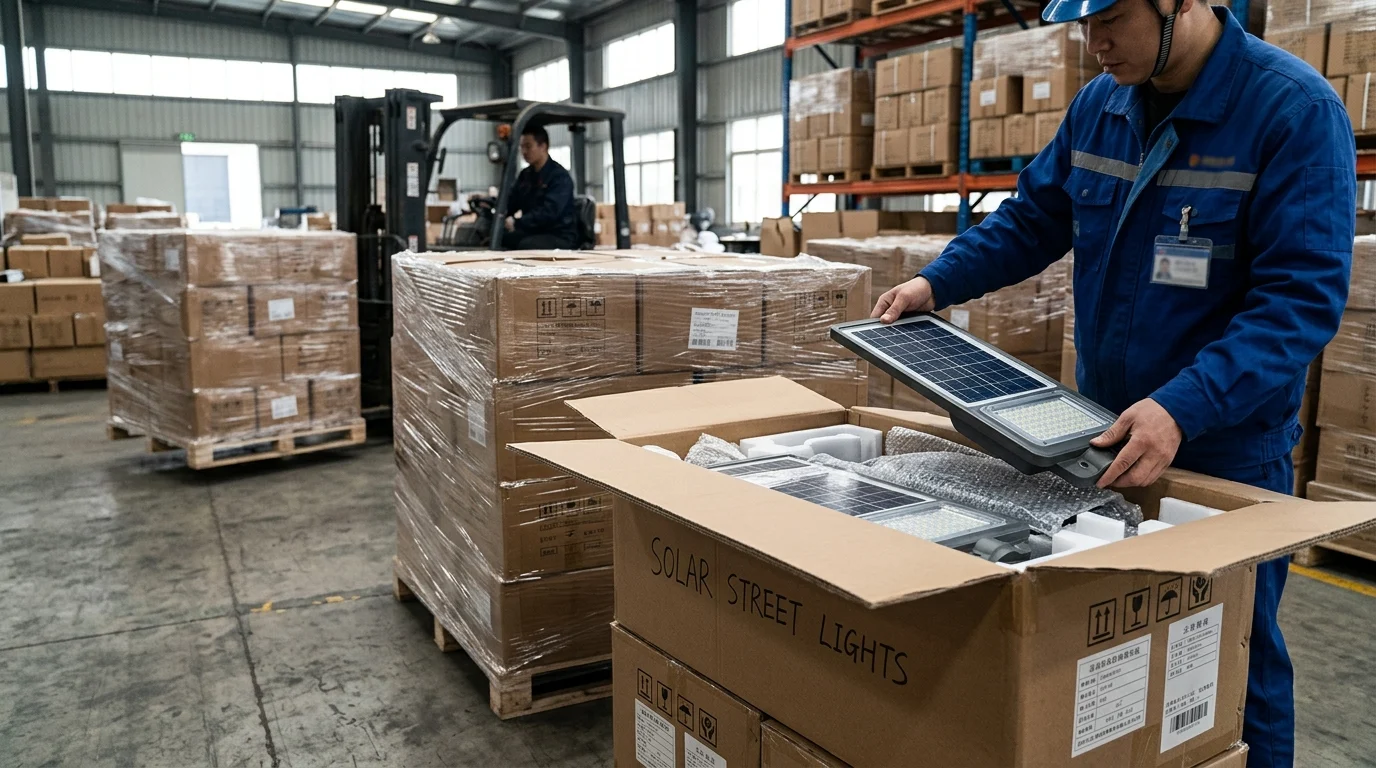
An OEM (Original Equipment Manufacturer) directly owns or operates the factory that produces the products.
OEM solar light manufacturers usually handle:
- Product assembly
- Component sourcing
- Quality control
- Product testing
- OEM logo printing
- Packaging customization
- Engineering support
- Production scheduling
Most professional OEM factories focus on specific product categories such as:
- Solar wall lights
- Solar flood lights
- Solar street lights
- Outdoor security lights
- Motion sensor lighting
Because production is managed internally, OEM manufacturers typically offer better control over quality, lead times, and customization.
What Is a Trading Company?
A trading company does not own the factory or production equipment. Instead, it works as an intermediary between buyers and manufacturers.
Trading companies often cooperate with multiple factories and combine different product categories under one supplier relationship.
This model offers more flexibility for buyers who need:
- Small trial orders
- Mixed product sourcing
- Lower MOQs
- Faster communication
- Multiple products in one shipment
For example, a trading company may source:
- Solar lights
- Flashlights
- Camping lanterns
- Headlamps
- Work lights
from different factories and combine them into one container shipment.
However, because production is outsourced, trading companies usually have less direct control over manufacturing and product consistency.
OEM Manufacturer vs Trading Company: Key Differences
Choosing between an OEM factory and a trading company depends on your sourcing priorities.
Here are the main differences buyers should understand.
| Feature | OEM Manufacturer | Trading Company |
|---|---|---|
| Factory Ownership | Owns production facility | No factory ownership |
| Production Control | Direct control | Limited control |
| Product Customization | High | Limited |
| Unit Pricing | Lower for bulk orders | Higher due to markup |
| MOQ | Usually higher | Usually lower |
| Product Categories | Specialized | Wide product range |
| Quality Control | More consistent | Depends on factory |
| Lead Times | Stable for long-term orders | Flexible for mixed orders |
Why Many Buyers Prefer OEM Solar Light Manufacturers
For long-term business growth, many professional buyers prefer working directly with OEM factories.
Better Product Customization
OEM factories usually support:
- Private label branding
- Custom packaging
- Product color customization
- Logo printing
- Customized specifications
Some factories also support custom molds and PCB design for larger projects.
This is especially important for distributors and brands building their own product lines.
Lower Costs for Bulk Orders
Because OEM factories eliminate intermediary markups, bulk pricing is often more competitive.
For large-volume orders, direct factory sourcing can significantly reduce long-term procurement costs.
This becomes especially important for:
- Wholesalers
- Importers
- Municipal projects
- Commercial outdoor lighting projects
More Stable Product Quality
Reliable OEM factories usually maintain stricter quality control systems.
Many professional solar lighting factories perform:
- Aging tests
- Waterproof tests
- Battery testing
- LED performance testing
- Incoming material inspection
This helps reduce defect rates and improves long-term product consistency.
When a Trading Company May Be the Better Option
Trading companies can still be a practical choice in certain sourcing situations.
Small MOQ Orders
Many OEM factories require higher minimum order quantities for customized products.
Trading companies often support:
- Smaller trial orders
- Mixed SKUs
- Flexible purchasing
This helps buyers test products before scaling larger orders.
Easier Multi-Product Sourcing
For buyers sourcing multiple outdoor product categories, trading companies can simplify purchasing.
Instead of contacting several factories separately, buyers can consolidate products through one supplier.
This may include:
- Solar lights
- Rechargeable flashlights
- Headlamps
- Camping lights
- COB work lights
Faster Product Selection
Because trading companies already cooperate with multiple suppliers, they may offer faster access to ready-made products.
This works well for:
- Amazon sellers
- E-commerce startups
- Seasonal buyers
- New importers
How to Verify a Reliable Solar Light Supplier
Whether you choose an OEM factory or a trading company, supplier verification is essential.
Before placing large orders, buyers should always check:
Factory Certifications
Reliable suppliers should provide certifications such as:
- ISO 9001
- CE
- RoHS
- FCC
- UL or ETL (depending on market)
Product Testing
Buyers should request:
- Waterproof testing reports
- Aging test videos
- Battery specifications
- LED testing data
- Real product photos
For outdoor solar lights, IP65 or IP66 waterproof protection is especially important.
Factory Photos and Videos
Real manufacturers should be able to provide:
- Production line videos
- Warehouse photos
- Testing room photos
- Packaging process videos
If a supplier avoids showing factory details, buyers should proceed carefully.
Sample Evaluation
Before mass production, buyers should always test samples carefully.
Check:
- Brightness performance
- Battery runtime
- Charging efficiency
- Waterproof performance
- Build quality
- Packaging quality
A reliable supplier should also respond quickly to technical questions and customization requests.
How to Choose the Right Supplier for Your Business
The best supplier depends on your business goals.
Choose an OEM Manufacturer If:
- You need OEM customization
- You want lower bulk pricing
- You plan long-term cooperation
- You require stable quality control
- You are building a private-label brand
Choose a Trading Company If:
- You need lower MOQs
- You want mixed product sourcing
- You are testing new products
- You are starting with small orders
- You prioritize convenience and flexibility
Final Thoughts
Choosing between an OEM solar light manufacturer and a trading company is not simply about price. The decision affects product quality, production transparency, customization capability, and long-term supply chain stability.
OEM factories usually provide stronger production control, better customization support, and more competitive pricing for large orders. Trading companies offer flexibility, lower MOQs, and easier multi-product sourcing for smaller buyers.
Before committing to any supplier, buyers should carefully verify certifications, inspect samples, review testing standards, and evaluate communication quality.
Working with the right partner can help reduce sourcing risks, improve product consistency, and support long-term business growth in the competitive outdoor lighting market.
If you are looking for OEM solar lighting solutions, feel free to contact our team for product catalogs, factory information, and customization support.
Post time: May-21-2026